Physical sunscreens: Burt’s Bees vs Badger

Monday, 21 April 2008

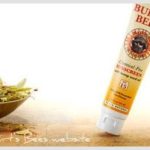
Burt's-Bees-Chemical-Free-Sunscreen-SPF30

Burt’s Bees is a brand of affordable natural personal care products that I loved until last year when the local distributor shared with me some bits of information about the line.  The information, along with news that the company was acquired by the bleach producing company Clorox,  created some unease for me and sort of killed my interest in their products.  I still use some of their lip balms and body lotion but I stopped buying anything new from them.   

But today, I gave them a look-over again, after learning that they’ve introduced the new Burt’s Bees Chemical-Free Sunscreen SPF 30, described as a 100% natural, non-whitening formula that provides broad-spectrum UVA/UVB protection using titanium dioxide.  

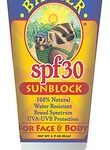
I was curious as to how the new Burt’s Bees Chemical-Free Sunscreen SPF30 measures up against Badger SPF30 Sunblock, currently rated the safest and most effective sunscreen by the Environmental Working Group since I view both of the brands in the same market positioning.

Zinc Oxide Vs Titanium Oxide
Without testing the new Burt’s Bees sunscreen, I can only compare based on their active ingredients and it looks like Badger SPF30 Sunblock provides better broad spectrum UVA and UVB sunscreen because the sunscreen contains 20.5% zinc oxide while Burt’s Bees Chemical-Free Sunscreen SPF30 contains 8.58% titanium dioxide. 

While both are physical sunscreens (also referred to as mineral sunscreens) which means they use titanium dixoide and or zinc oxide as active ingredients to form a film on top of the skin that reflects or scatters UV light and are effective immediately upon application, the mineral zinc oxide is a more superior sunscreen ingredient compared to titanium dioxide to provide the best broad spectrum UVA and UVB sunscreen (source).   And by looking at the concentration, Badger SPF30 Sunscreen is definitely more protective against long-wave UVA.  Just refer to the following rating compiled by Environmental Protection Agency.

titanium-dioxide-zinc-oxide.bmp

However, even though zinc oxide is less white compared to titanium dioxide at a given concentration, Badger SPF30 Sunblock does not do better in that regards because of the high concentration with 20.5% zinc oxide.  I have also tested the product and it left an unsightly white cast upon application.     

Well, I’m currently use the Mexoryl-based sunscreens but I really prefer physical sunscreens over chemical sunscreens because much research have revealed the latter to be free radical generators containing gender-bending estrogenic chemicals.  But would I buy the new Burt’s Bees SPF30 Sunscreen just because it’s chemical-free? 

I think the answer is obvious.

So what would you buy since both products cost about the same?

© Copyright Notice

stumble it! Stumble This Post | Subscribe to my RSS Feed
Posted in Sunscreen| 4 Comments »

Avoid sunscreens containing Oxybenzone

Thursday, 10 April 2008

mineral-sunscreens-chemical-sunscreens

One of the key reasons I’m uncomfortable with using chemical sunscreens is because studies at all levels have proven that chemical sunscreens penetrate the skin, get into the bloodstream and are harmful to the body.  As a matter of fact, a widely-used sunscreen ingredient called Oxybenzone, also known as Benzophenone-3, has been linked to allergies, hormone disruption, and cell damage with a new study recently published by the U.S. Centers for Disease Control (CDC) to back it up.

According to this analysis from Environmental Working Group (EWG), findings of the CDC study indicate that Oxybenzone reacts negatively with sun exposure and have negative impacts on our bodies such as: 

- triggering possible allergic reactions by sun exposure.
- forming free radical chemicals that may be linked to cell damage.
- disrupting the hormone system.
- absorbing through the skin in significant amounts.
- accumulating in the fatty tissues in the body for many days. 
- helping other chemicals penetrate the skin.

A companion study released a day earlier also revealed that mothers with high levels of Oxybenzone in their bodies were more likely to give birth to underweight baby girls.  And what’s also alarming is on top of the many sunscreen products in the market that contain this harmful ingredient, companies also use the toxic chemical in other personal care products, including lip balm, lipstick, moisturizers and fragrance for women.

I know many have criticized EWG as a scare mongrel, but I’m in support of their stance especially since they’ve always back their analysis with studies as in this case.  Moreover, just think about the amount of sunscreen you have to slap on just to get adequate protection and think about how much toxins you’re subjecting yourselves to in the longer term if yours contain Oxybenzone.   

So gals, let’s do ourselves a favor.  Read the ingredient list of your sunscreens and for the matter, all your personal skincare products and look out for Oxybenzone to avoid.  Afterall, we do have plenty of safer choices. 

For a safe list of sunscreens, look up Skin Deep Cosmetics Safety Database.

© Copyright Notice

stumble it! Stumble This Post | Subscribe to my RSS Feed
Posted in Health, Sunscreen| No Comments »

Sunscreens: Capital Soleil vs Anthelios XL

Wednesday, 9 April 2008

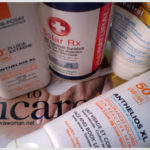
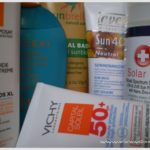
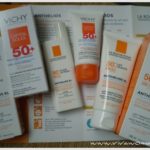
Vichy-Capital-Soleil-La-Roche-Posay-Antheloios-XL

These are from my recent Mexoryl-based sunscreen loot:

  1. Vichy Capital Soleil SPF 50+  Face Cream For Reactive Skin    
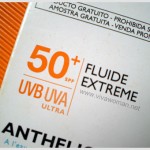
  2. La Roche-Posay Anthelios XL SPF 50+ Fluide Extreme For Face 
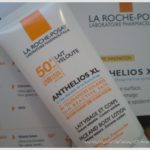
  3. La-Roche-Posay Anthelios XL SPF 50+ Lait Veloute Face & Body Lotion

In my earlier entry about Mexoryl-based sunscreens for maximum protection, I mentioned I wanted to get one or two to try out but eventually, I went out to buy three of them.  They were all below S$40 and La Roche-Posay Anthelios XL 50+ Fluide Extreme in particular was even going for under S$20 with a special promotion.  So it was really hard to resist.

Protection
In terms of formulation, La Roche-Posay Anthelios XL 50+ Fluide Extreme For Face and La-Roche-Posay Anthelios XL 50+ Lait Veloute Face & Body Lotion are more superior because both contain Mexoryl SX and Merxoryl XL, a combination that is said to be the most potent photostable anti-aging sun filters for UVA and UVB rays.  Mexoryl SX or XL alone does not provide complete protection.  Just refer to the following rating compiled by Environmental Protection Agency and note that Ecamsule is the other name for Mexoryl.

ecamsule.bmp 

Vichy Capital Soleil 50+  Face Cream For Reactive Skin also offers very high protection but the sunscreen only contains Mexoryl XL.  But this formulation contains Eperuline, a sensitivity regulator and is therefore most ideal for those with allergic and very sensitive skins, limiting the chain of events leading to sun intolerance reactions.

But since I don’t have sensitive skin, I find that using the La Roche-Posay Anthelios XL range gave me better peace of mind because the formulation promise better total protection and they even come with Titanium Dioxide and Octocrylene.

Texture
All three sunscreens give fabulous velvety protection and left no white marks or greasy effects upon application.  In fact, La Roche-Posay Anthelios XL SPF 50+ Fluide Extreme For Face which is in milky form left no trace of oil at all on my face.  Vichy Capital Soleil SPF 50+  Face Cream For Reactive Skin is creamy on contact but again, left my face almost greaseless.  However, this is because both products contain alcohol denat which drys and strips your skin’s moisture when used overtime. 

La Roche-Posay Anthelios XL SPF 50+ Lait Veloutte Face & Body Lotion is much more creamy, feels a tad oily upon application but it dries up pretty fast on my hands, leaving no greasy marks.  When applied on my face, my skin did feel slightly greasy though it was manageable.  The good thing is that I didn’t see alcohol denat on the ingredient list for this product.

Summary
I have to concede that all the three Mexoryl-based sunscreens work great on our skin but for the sake of comparison, La Roche-Posay Anthelios XL range is better especially the La Roche-Posay Anthelios XL SPF 50+ Lait Veloutte Face & Body Lotion which is also water resistant.

But honestly, I’m not exactly comfortable using these chemical sunscreens even though they promose ultra protection because of their ingredients.  Even if they do not contain alcohol denat, they contain a whole lot more chemical ingredients compared to mineral sunscreens.   The only attraction for me about chemical sunscreens with Mexoryl is that you’re virtually impervious to sun exposure.  As I mentioned in my earlier entry, Mexoryl is photostable and this means you can wear it all day long without the need to reapply and yet receive long lasting, effective protection as it does not degrade in sunlight. 

I guess I will continue to wear these for awhile given the fact it has been exceptionally sunny on most days now.  I will most probably however, just limit to my hands and switch back to mineral based sunscreens for my face.

And please also read my post on tips on sunscreen protection & application.

© Copyright Notice

***½
stumble it! Stumble This Post | Subscribe to my RSS Feed
Posted in Face, Sunscreen, VivaReviews| 6 Comments »

Mexoryl sunscreens for maximum protection

Thursday, 20 March 2008

Mexoryl sunscreen

Even though I’m a fan of physical sunscreens, I’m now keen to try out the chemical sunscreens under Vichy Capital Soleil and La Roche-Posay Anthelios because these feature Mexoryl XL and Mexoryl SX which are said to be the most potent photostable anti-aging sun filters for UVA and UVB rays. 

Here is a summary of information I have uncovered regarding these two potent sunscreen chemicals:

Offers complete protection against both UVB and UVA rays
It should be noted that most sunscreens available right now offer only partial protection because they only protect against UVB rays.  But Mexoryl, which was developed by scientists at L’Oreal, is said to be virtually impervious to sun exposure because it is the only chemical that can block UVA rays which are responsible for our wrinkles, sun damage and certain skin cancers.  In fact, it has been reported that when both Mexoryl XL and Mexoryl SX molecules are combined, they provide complete protection against both UVB and UVA rays.

Provides optimum protection all day long
Mexoryl is photostable and this means you can wear it all day long without the need to reapply and yet receive long lasting, effective protection as it does not degrade in sunlight. 

Works well with mineral makeup formula
The two Mexoryl molecules are able to work synergistically with each other and with other sunscreen filters including avobenzone (Parsol 1789), titanium oxide and zinc oxide to provide full spectrum protection against both UVA and UVB rays.  So unlike what I’ve discussed in my earlier entry regarding the incompatibility of non-micronized mineral makeup with an avobenzone containing chemical sunscreen, you should be able to wear Mexoryl chemical sunscreen with your mineral makeup, unless the formula comes with avobenzone as well.

Poses no health risks
Studies have shown that  less than 0.1% of a Mexoryl application is absorbed by the body and this minimal absorption means that it is very safe to use.   In addition, Mexoryl SX is water soluble, which means any that is absorbed is likely to be rinsed out quickly.  Moreover, Mexoryl formulated sunscreens have passed various safety tests and have been approved for usage in Europe for over a decade now.

Provides water resistance
Mexoryl XL is oil soluble and formulations containing Mexoryl XL are well suited for outdoor active usage on extended periods.  Mexoryl SX on the other hand is water soluble and is recommended for daily wear.

Choices of Mexoryl sunscreens
Besides Vichy Capital Soleil and La Roche-Posay Anthelios, I understand that other sunscreens with Mexoryl include Lancome Sunblock UV Expert 20 with Mexoryl, Loreal Revitalift UV with Mexoryl SX and Kiehl’s UV Protective Suncare Sunscreen Cream For Face & Body. 

I’ll probably like to try one or two of these for outdoor application first and see how they perform.  If I like them enough, I may then start to use them on a more frequent basis.  And hopefully, I’ll be able to post up some positive reviews too.

Update:
Please read my post Is Zinc Oxide The Best Sunscreen Ingredient? for a comparison between Zinc Oxide and Mexoryl.

© Copyright Notice

stumble it! Stumble This Post | Subscribe to my RSS Feed
Posted in Sunscreen| 4 Comments »

  • Sticks and Stones
  • Lady Language

  • BeautyTips

    Using a toner will help remove any traces of leftover dirt, bacteria or oil that your cleanser might have missed.


  • Archives


    • Subscribers


    • Search